

This month, London-based artist, filmmaker and 2018 Jarman award-winner Daria Martin鈥檚 Tonight the World takes over The Curve at Barbican Centre, London. Part of the institution’s Life Rewired season, it uses film and computer gaming technology to explore the vivid dreamscapes of her grandmother 鈥� an artist who fled from the Holocaust.
A: The work deals with ideas of trauma, migration, loss and resilience. Why is it so important to shed light on personal stories, especially within the context of 2018?
DM: The truly personal is not only biographical; it resonates more broadly. As second wave feminism taught us, 鈥渢he personal is political鈥� and, in this context, I hope my grandmother鈥檚 stories invite empathy. In 2018, when so much cultural debate is divided, the more we can break down fear of the 鈥渙ther鈥� through granular, personal, specific stories, the better.
A: What is the historical and psychological significance of these works?
DM: The Curve show reinterprets an archive of my grandmother鈥檚 dream diaries, specifically the dreams that recall her childhood home in Brno, then Czechoslovakia, which she fled prior to the Holocaust. Recorded decades later, the dreams represent a return to the home that she never made, physically. My film and videogame, based on the dreams, re-embody these visions.
A: Tonight the World combines film and computer game technology to create immersive environments. How do these digital methods amplify the meaning of the work?
DM: They work quite differently. The film was shot on analogue 16mm and transferred to HD, and gives the dreams full body and affect. It鈥檚 a softer and more sculptural medium and implies, for me, an emotional restoration of my grandmother鈥檚 history. The digital game is something different: its smooth surfaces imply a more distant and cooler approach, perhaps the instinct to hold this history at arm鈥檚 length.
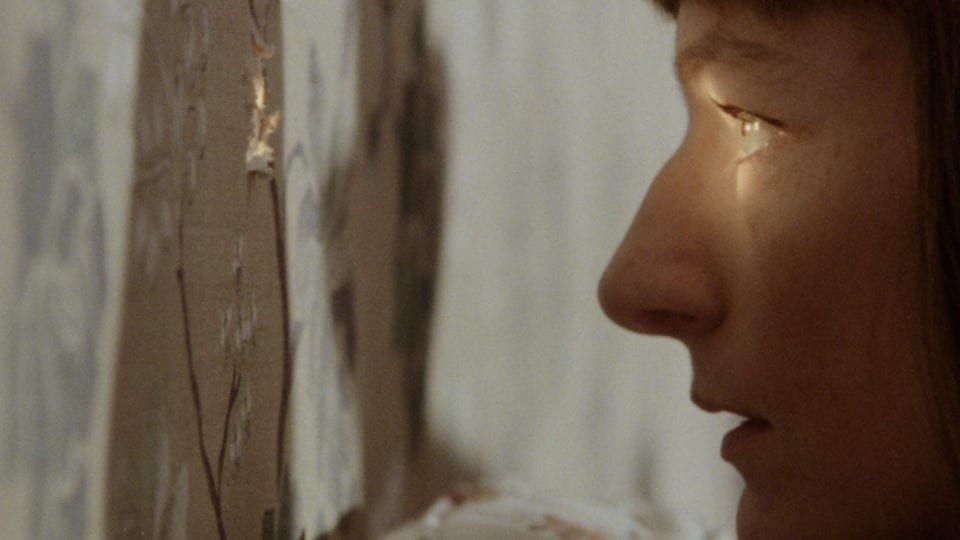
Anamorphic 16mm film transferred to HD 13.5 minutes © Daria Martin.
A: Why is it important to embrace new media within the contemporary arts landscape 鈥� and how is it developing into the future?
DM: Regardless of importance or developments, it鈥檚 something that happens organically; it doesn鈥檛 need to be forced. Artists have the full range of possible materials, methods, and subjects at their fingertips. My young students at the Ruskin use new media as second nature.
A: The show explores a variety of real and conceptual spaces, including dreamscapes. How do they engage with The Curve鈥檚 unique architecture, and does it enhance the piece?
DM: I鈥檓 interested in the fact that The Curve was built as a sound buffer that wraps around the back of the auditorium; it was intended to be a hidden space. The interior of The Curve is actually rather strange and contains all sorts of nooks and doors. It鈥檚 an apt space to explore dreams and dream language.
A: The exhibition is part of the Barbican鈥檚 2019 season, Life Rewired, which explores what it means to be human when technology is changing everything. How does Tonight the World balance deeply personal stories with digital elements?
DM: The exhibition includes various interpretations of the dreams, including, as we鈥檝e discussed, the 16mm film, and the game playthrough, but also the diary pages themselves, which were rigorously organised and densely typed. All of these are forms of technology. They register at different emotional temperatures, but it鈥檚 up to us as humans to work out how they can each, in turn, serve our needs.
Tonight the World runs 31 January-7 April. Find out more
Lead image: Daria Martin, Tonight the World, 2019. Anamorphic 16mm film transferred to HD 13.5 minutes © Daria Martin.


